In the age of hyper-connectivity in part due to social media, society, otherwise known as public, has essentially leveled the playing field with organizations. Gone are the days when an organization can neglect the concerns of their respective publics. Yet, the Public relations practice is strongly driven by perspectives. Over the years, organizations have failed to successfully satisfy their respective publics in part because of one-way of thought. Through diversity or the lack thereof, not just only from a physical sense, but from a thought and authority perspective, it impacts organizations both internally and externally.
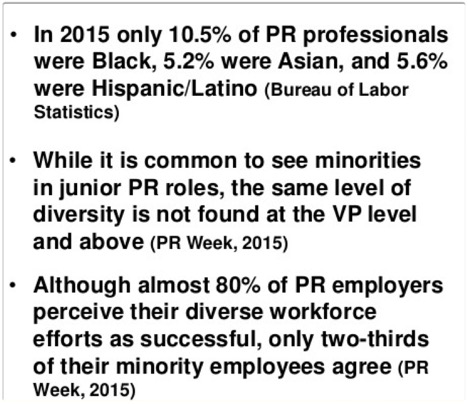
Below are the three trends I developed upon completing my research.
Trend 1: Intersectionality
Organizations fail to understand that you cannot just treat race and gender as their own. That there is an overlap between identities.” (Vardeman-Winter, J., 2011). Public Relations professionals must strive to create campaigns that are not solely one size fits all. (Vardeman-Winter, J., 2011). Internally, it is a difference between one gender thriving over another regardless of how many, or how little they may be. (Bardhan, N., 2013).
Trend 2: Equity
Internally, organizations need to create an environment in which people of diverse backgrounds have an equal opportunity to influence the decisions that are being made. (Choi, S., & Rainey, H. G., 2014). By establishing equity, an organization can extend their reach to new markets and can maintain positive relationships with their current publics, from an external point of view.
Trend 3: Inclusion
It’s one thing to have a diverse work environment that is reflective of our extremely diverse society, but what are organizations doing to incorporate these individuals. What internally is being provided to comfort these individuals emotionally. (Choi, S., & Rainey, H. G. 2014). Professionally, what is being done to help retain and grow diverse talent. Externally are organizations advocating on issues that isn’t commonly associated with them. (Logan, N., 2016).
 Theories & Research Methods
- Religion
- Gender & Race
- Agenda Setting Theory
- Framing
- Qualitative & Quantative
Case Study: IBM’s “Hack A Hair Dryer” Campaign
 IBM is short for International Business Machines. They are a computer hardware company headquartered in Armonk, New York. Generally speaking, there has been a huge push by the country to address STEM, short for Science Technology, Engineering, and math. “According to the U.S. Department of Labor, only 5% of U.S. workers are employed in fields related to science and engineering, yet they are responsible for more than 50% of our sustained economic expansion.” (Adkins 2012)
In response to such alarming statistics, many organizations and the country as pushed for many STEM programs within schools. Outside of STEM, IBM is a part of “Silicon Valley” which is a nickname of the southern portion of the San Francisco Bay Area and home to many tech organizations such as Apple and Google. However, in recent years, there has been a discussion on addressing diversity within Silicon Valley. Data shows that Silicon Valley consists of predominately white males 71% to be exact. On the other hand, 29% of employees are women.
In response to the problem addressed many companies have created campaigns/initiatives to address such issue. Unfortunately, not all have been effective in their messaging IBM being one of them. In 2015, to encourage women both young and old to peruse a career in coding and to change the perception of women in tech. The campaign was titled “#HackAHairDryer” IBM created a video that was focused on hair dryers and girls using hair dryers for their science projects
As expected it failed. It failed for the simple fact that it stereotyped and pigeon-hole women into traditional gender stereotypes. The public had a field day with IBM in particular women within STEM fields. “I code. But it’s to mess around with salamander DNA sequences, not hairdryers,” said Cathy Newman, a biology Ph.D. student.
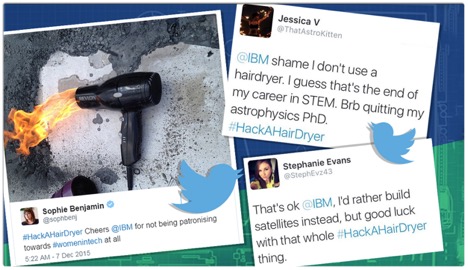
After enough backlash from the public, IBM offered a public apology and within two months took down the promotional video and ended the campaign.
Why Diversity ?
- Multiple viewpoints
- Better understanding customers
- Enhancing client connections
- Delivering insights into trends

In summary, as our world grows so will issues surrounding diversity if it is not addressed accordingly. We are at a point where publics can no longer be ignored. They have the ability to cause havoc within a matter of seconds as a result of social media.
Also, diversity is more than just having a physical representation of diverse employees within the workplace. There must be programs and resources put in place to make them feel included in the overall function of a business. Also, growth, when diverse candidates enter your organization what are you putting in place to make sure that they can grow and develop to become potential VP and above and not remain as juniors forever.
Secondly when creating campaigns for diverse audiences, one must avoid having a one size fits all approach towards campaign execution. Not all audiences are the same. Factors such as race, gender, sexuality, location, religious beliefs, etc. all play a role in one’s identity.

“Strength lies in differences, not in similarities”
-Stephen R. Covey









 or me to have a chance to see him live at the Saint Pablo Tour.
 Kanye performed the whole night on the stage, which made for a unique and amazing concert experience. what I enjoyed the most besides seeing him perform live was the fact that there was no such thing as a good seat —unless if you were at the floor level in my opinion— everyone had a good view of Kanye. Overall it was an amazing experience and I recommend everyone to check it out.